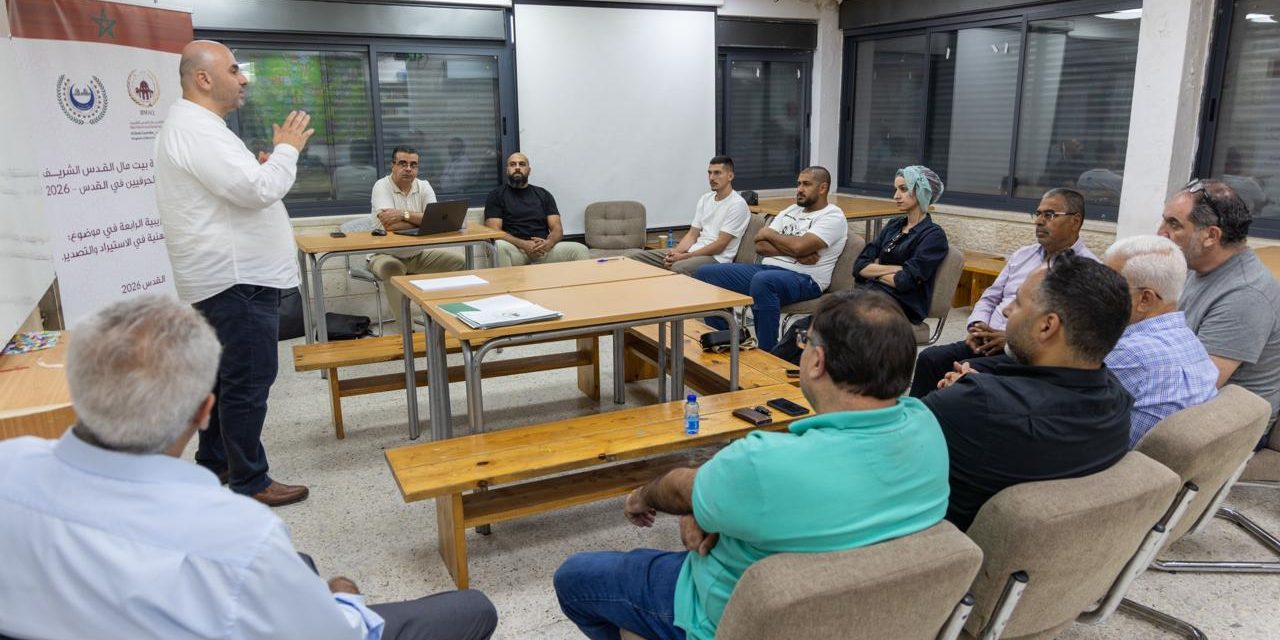
Jerusalem – The Bayt Mal Al-Quds Asharif Agency (BMAQ), the executive arm of the Al-Quds Committee chaired by His Majesty King Mohammed VI, concluded a series of training sessions for Palestinian traders in Jerusalem and its surrounding areas on “Professional Competence in Import and Export.” The programme benefited nearly 100 Jerusalemite participants.
The initiative concluded with its fourth and final session, organized in partnership with the Arab Chamber of Commerce and Industry in Jerusalem. The closing ceremony included the presentation of certificates to traders, business owners, entrepreneurs, and professionals from commercial enterprises who successfully completed the training.
The sessions addressed key aspects of international trade, including market expansion strategies, international commercial contracts, customs clearance procedures, supply chain management, and the mitigation of financial and legal risks.
Participant Bushra Khalil Abbasi said the training gave her a clearer understanding of import and export procedures, the legal framework governing them, and the relevant authorities involved in conducting trade operations in full compliance with applicable regulations.
Jerusalemite trader Imad Mahmoud Abu Ghazaleh, from Jerusalem’s Old City, said he joined the programme while preparing to launch a business importing products from Europe. He noted that the training helped him better understand import and export procedures and avoid potential challenges and unnecessary costs, particularly given the difficult conditions facing traders in Jerusalem.
Participants emphasized the programme’s importance in strengthening the skills and capacities of Jerusalemite traders and praised BMAQ’s initiatives for creating new opportunities to expand their businesses and enhance their competitiveness.
Wael Hijazi, Adviser to the Arab Chamber of Commerce and Industry in Jerusalem, said the training had improved traders’ practical knowledge of import and export procedures, enabling them to complete transactions more efficiently while reducing errors that could lead to shipment delays and additional costs.
Training expert Hani Jaber added that the programme had strengthened participants’ professional competencies and equipped them with the skills needed to engage more effectively in international trade. He noted that a sound understanding of customs procedures and tariff classifications helps reduce avoidable costs arising from procedural errors, while greater participation in international trade supports business growth and commercial activity.
The training series forms part of BMAQ’s 2026 programme to support traders and artisans in Jerusalem. As a follow-up, participants involved in import and export activities will continue to receive free technical guidance and mentoring over the next three months through dedicated communication channels with the programme’s experts.