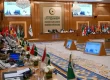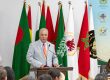
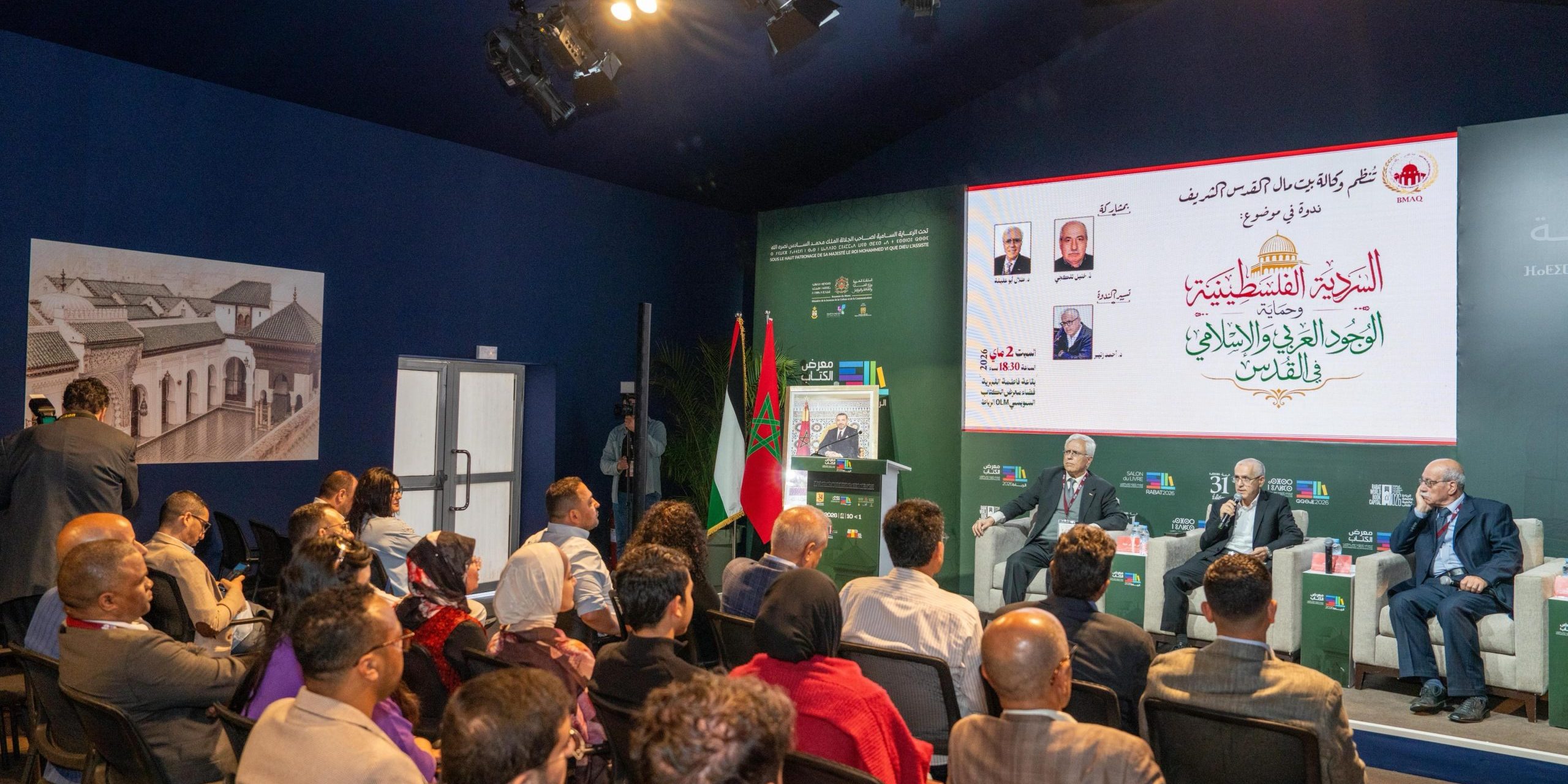
Rabat – Researchers Khalil Tafakji and Talal Abu Afife presented in Rabat their vision on the topic: “The Palestinian Narrative and the Protection of the Arab-Islamic Presence in Jerusalem”, during a symposium organized by the Bayt Mal Al-Quds Asharif Agency (BMAQ) at the International Publishing and Book Fair, in the presence of the Director of BMAQ Mohamed Salem Echarkaoui.
The two researchers stressed the need to address the limitations of media coverage and the weakness of Arab scholarly output on Jerusalem’s religious and civilizational significance. They underlined the importance of a comprehensive discourse that recognizes Jerusalem’s shared Islamic-Christian identity, as well as a “neutral” narrative that challenges the historical claims of the Israeli far right on account of their lack of scientific grounding.
Khalil Tafakji, Director of the Maps Department at Bayt Al-Maqdis in Jerusalem and author of “Settlement in Jerusalem,” highlighted Morocco’s efforts, under the leadership of His Majesty King Mohammed VI, Chairman of the Al-Quds Committee, to strengthen the resilience of the Palestinian people in Jerusalem through support for education, social institutions, and urban restoration projects, particularly in light of restrictions preventing Palestinians in Jerusalem from building in East Jerusalem.
He highlighted Jerusalem’s significance to the three religions and pointed to the contradictions between the Palestinian and Israeli narratives, stressing the measures taken by the occupation authorities to impose their version on the ground.
In the same context, Tafakji warned against Israel’s “Judaization” policies targeting geography through the replacement of Arabic street and place names with Hebrew ones, alongside demographic changes in occupied East Jerusalem aimed at reducing the Palestinian population, as well as efforts to reshape the Palestinian narrative through revisions to educational curricula.
Writer and legal advisor Talal Abu Afife stressed that Jerusalem is engaged in a difficult, ongoing existential struggle to defend its identity and authentic historical narrative against attempts to alter reality. He praised Morocco’s support, particularly through the work of BMAQ, which operates quietly yet effectively to strengthen the resilience of Jerusalem’s residents.
He drew attention to direct attempts to obliterate the city’s cultural identity through the closure of cultural institutions and the banning of children’s recreational activities, aimed at erasing Arab, Islamic, and Christian landmarks, noting that the city is being “demographically and geographically eroded on a daily basis.”
Abu Afife affirmed the commitment of intellectuals and civil society to strengthening Palestinian national identity in Jerusalem through ongoing field initiatives, including efforts to safeguard intangible heritage such as promoting traditional Palestinian dress (the qambaz and headscarf for men, and embroidered dresses for women), and raising awareness among younger generations.
BMQ is participating in the 31st edition of the International Publishing and Book Fair, running until May 10, 2026, with a pavilion showcasing its latest publications and a special children’s space presenting products from the “Hayya” platform, which aims to promote the values and virtues of Jerusalem among younger generations.
The Agency will also organize another symposium on Tuesday, May 5, 2026, on the theme: “Jerusalem through Moroccan Eyes: in Biographies, Social Classes, and Palestinian Aesthetic Production”, presenting the results of research projects carried out this year at the “Bayt Al-Maqdis” Center for Research and Studies in Rabat and the Chair of Moroccan Studies at Al-Quds University.