Four Palestinian poets, representing different currents within the Palestinian poetic tradition, were honored with the Argana International Award for Poetry in its eighteenth edition, coinciding with the designation of Rabat as the World Book Capital for 2026 by the UNESCO.
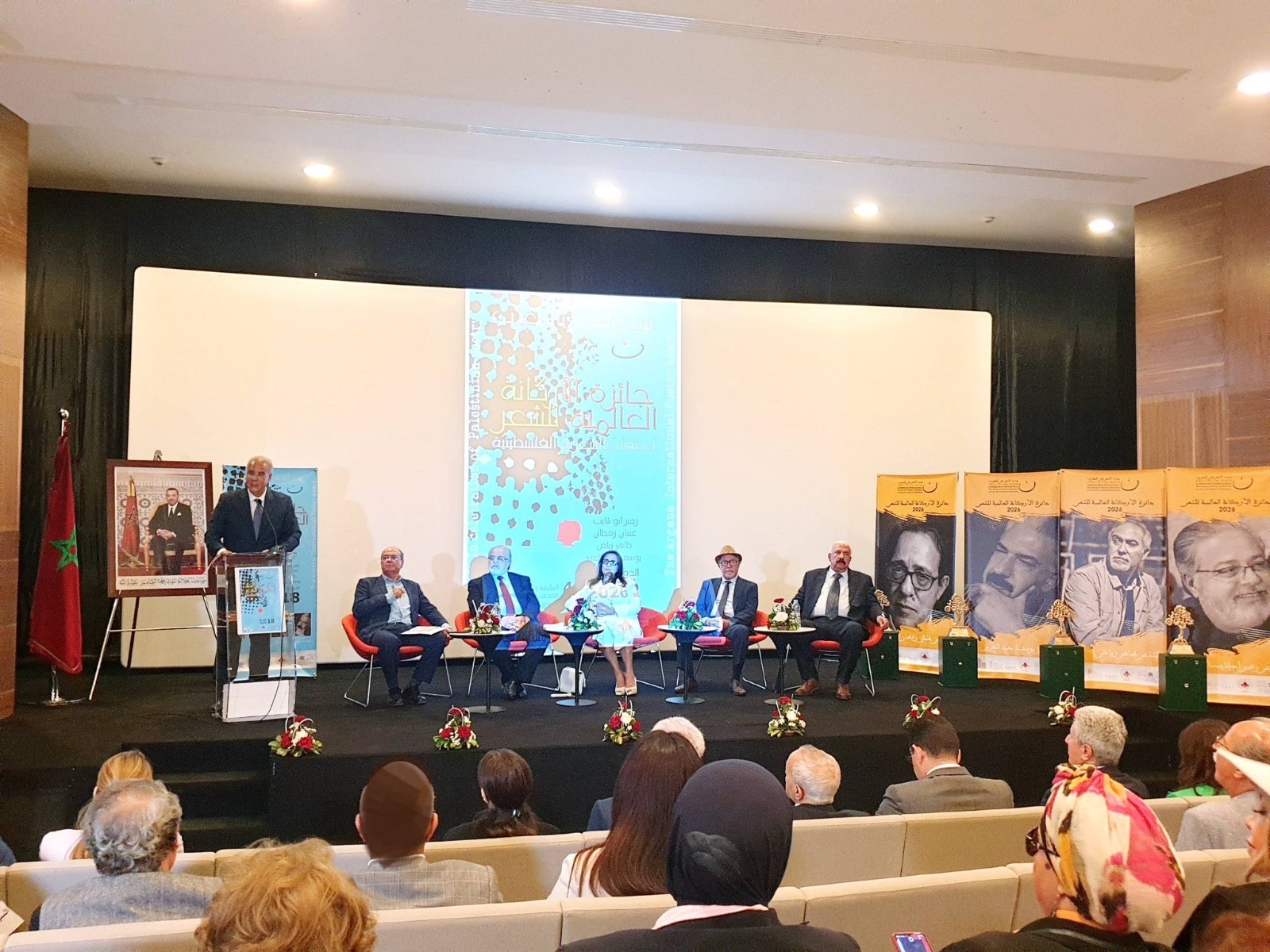
The Argana International Award for Poetry, organized by the House of Poetry in Morocco with the support of the Ministry of Youth, Culture and Communication and the Bayt Mal Al-Quds Asharif Agency (BMAQ), was presented in Rabat in the presence of laureates Youssef Abdelaziz, Taher Riyad, and Zuhair Abu Shaib. Ghassan Zaqtan was unable to attend due to health issues that prevented him from travelling to Morocco.
The award-winning poets expressed their deep appreciation for "Morocco’s steadfast cultural support for Palestine", noting that the prize has contributed to reinforcing the longstanding bonds of fraternity and shared cultural heritage between Morocco and Palestine.
Mourad El Kadiri, President of the House of Poetry in Morocco, stated that "awarding the prize to four Palestinian poets was not merely intended to broaden recognition of Palestinian poetry—whose presence and influence have long been deeply rooted in Arab and global cultural consciousness since the mid-twentieth century—but rather to affirm a broader vision of the prize, one grounded in creative plurality and in celebrating the diversity of voices, artistic expressions, and aesthetic sensibilities that characterize Palestinian poetry.”
He added that “over the years, Palestinian poets have succeeded in elevating their cause through poetry to the realms of metaphor and the paradises of dreams. As a result, Palestine is no longer merely a political subject but has become a cultural and poetic cause.”
For his part, Mohamed Mehdi Bensaidn, Ministry of Youth, Culture and Communication, noted that the Argana Award for Poetry has taken on deeper significance this year through its recognition of Palestinian poetry, describing the initiative as one that transcends literary acclaim to become “a celebration of beauty in the face of suffering, and of life in defiance of oblivion.”
Bensaid added, during the ceremony attended by several Arab ambassadors and representatives of international organizations—including the UNESCO representative for the Maghreb region—that this tribute is in keeping with the steadfast position of Mohammed VI, Chairman of the Al-Quds Committee, who regards the Palestinian cause as a national cause for Morocco. He also conveyed Morocco’s heartfelt greetings—on behalf of its King, government, and people—to Palestine, “which holds a cherished place in our hearts.”
Mohamed Salem Echarkaoui, the Director of BMAQ, said that the Moroccan Argana “shade” now expands “to grant us the honor of connecting with our brothers in Palestine,” through honoring this vibrant and inspiring poetic presence.
Echarkaoui noted that honoring the Palestinian poetic experience through the Argana International Award for Poetry reflects a high expression of Morocco’s consistent and principled commitment to solidarity.
He also pointed out that this year’s jury was composed of Moroccan poets, writers, artists, and academics, chaired by Lamrani, and including Abdelrahman Tankoul, Ahmed Jarid, Jamaleddine Benhyon, poet and translator Noureddine Zoitni, and poet Hassan Najmi.
The House of Poetry in Morocco stated in a press release issued by the jury that honoring Palestinian poetry with the Argana International Award is a celebration of a body of work characterized by “the plurality of voices, the diversity of experiences, and a continuous effort to expand the space of poetry.”
The committee stated that awarding Palestinian poetry through four distinct poetic voices represents “a form of poetic friendship that has always marked Morocco’s cultural relationship with this poetry; a friendship grounded in an appreciation of its universal dimension and of its distinctive diversity within that very dimension.”