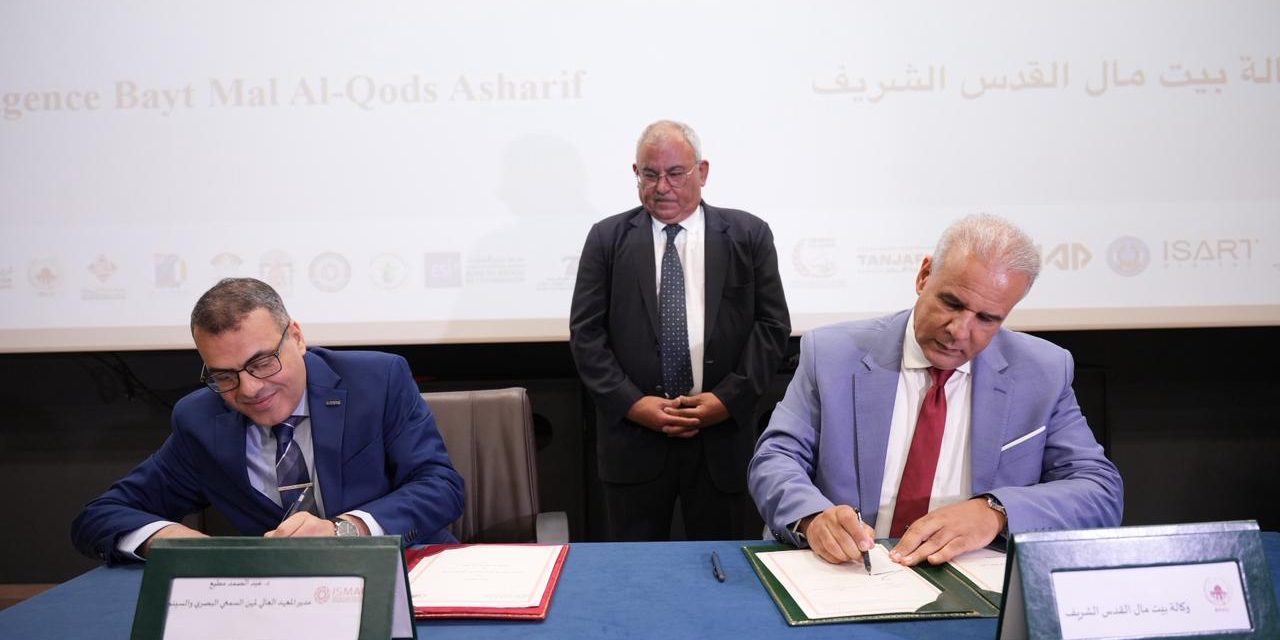
Rabat – The Bayt Mal Al-Quds Asharif Agency (BMAQ), operating under the Al-Quds Committee chaired by His Majesty King Mohammed VI, and the Higher Institute for Audiovisual and Cinema Professions (ISMAC) signed a cooperation agreement on Wednesday in Rabat that will enable Palestinian students from Jerusalem to pursue academic studies and specialized professional training in the institute’s areas of expertise.
The agreement was signed by BMAQ’s Acting Director, Mohammed Salem Echarkaoui, and the Institute’s Director, Abdelsamad Moutiaa, in the presence of Abdelaziz Boujdaine, Secretary-General of the Ministry of Youth, Culture and Communication – Communication Sector. Under its provisions, Palestinian students from Jerusalem will be granted access to training opportunities and academic residency programmes in the fields of audiovisual media and cinema..
Under the agreement, the Institute will develop and deliver specialized training programmes and workshops in the fields of cinema and television for Palestinian youth and media professionals from Jerusalem through short- and medium-term academic residencies, in accordance with its established educational standards. For its part, the Agency will mobilize the funding required to support these initiatives and provide scholarships to Palestinian students, enabling them to pursue their studies and complete their graduation projects whenever necessary.
The agreement’s preamble notes that this initiative is being implemented in accordance with the directives of the Moroccan monarch to BMAQ to “continue implementing tangible projects with a lasting impact on all segments of the Palestinian population in Jerusalem.” It further underscores that the initiative reflects “the Kingdom of Morocco’s steadfast commitment to supporting the Palestinian cause and defending the Holy City of Jerusalem.”
The preamble further emphasizes the two parties’ shared belief in the power of images and digital media to strengthen the resilience of the Holy City, preserve its civilizational memory, and communicate the Palestinian narrative to global audiences. It notes that this conviction forms the foundation of a partnership that brings together academic expertise in audiovisual media and cinema with field-based development initiatives, translating efforts to safeguard Jerusalem’s cultural and civilizational identity into concrete action. The agreement also seeks to harness the unique capacity of photography, film, and audiovisual media to document and preserve the collective memory of the Palestinian people.