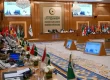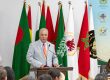
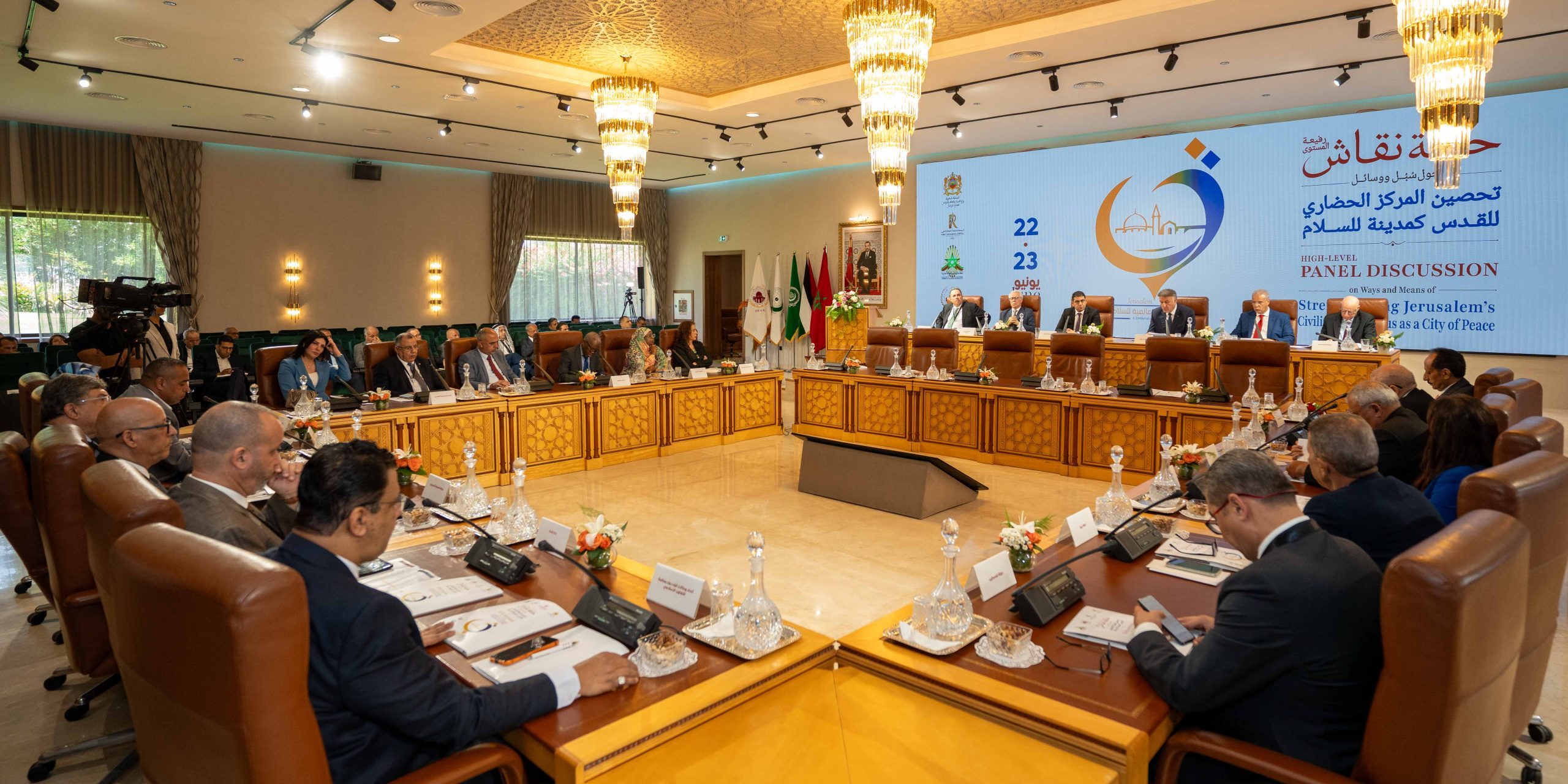
Rabat – A high-level discussion on strengthening Jerusalem’scivilizational status and reinforcing its role as a city of peaceopened today, Monday, in Rabat, under the theme “Jerusalem:A Symbol of a Universal Narrative of Peace,” bringingtogether media officials, experts, academics, and professionals.
The session, organized by the Bayt Mal Al-Quds AsharifAgency (BMAQ) in partnership with the Academy of the Kingdom of Morocco and the Ministry of Youth, Culture and Communication – Communication Department, forms part of the resolution adopted on 26 November 2025 by the 55th session of the Council of Arab Information Ministers, whichdesignated Rabat as the Arab Media Capital for 2026, withdedicated programming on Jerusalem. It highlights the Kingdom of Morocco’s role, under the leadership of HisMajesty King Mohammed VI, Chairman of the Al-QudsCommittee, in fostering dialogue on humanitarian and civilizational issues, foremost among them Jerusalem and Palestine.
In his address, the Minister of Youth, Culture and Communication, Mohamed Mehdi Bensaid, underscored thatthe meeting is being held amid a highly sensitive international and regional context, marked by a growing need to reaffirmshared human values and reinforce a culture of dialogue and mutual understanding among peoples as the most effective way to address conflicts and build a future grounded in security, stability, and mutual respect.
Mr. Bensaid added that the Kingdom of Morocco, under the leadership of His Majesty King Mohammed VI, continues to pursue sustained diplomatic, political, and humanitarianefforts to safeguard Jerusalem’s legal and historical status, preserve its civilizational identity, support the resilience of itsinhabitants, and advance initiatives that strengthen the prospects for a just and lasting peace.
He further stressed the importance of developing a universalnarrative on Jerusalem rooted in shared human values, one that highlights its civilizational and cultural significance and enables younger generations to engage with it as a model for intercultural, interfaith, and inter-civilizational dialogue.
For his part, the Head of Palestinian Official Media, Ahmed Assaf, said that Jerusalem stands as a model of religious and cultural diversity and coexistence among differentcivilizational components, emphasizing that safeguarding thishistorical and human character is essential to reinforcing the values of peace and dialogue..
Mr. Assaf praised the important role played by His MajestyKing Mohammed VI, Chairman of the Al-Quds Committee, in defending Jerusalem and the Palestinian cause, expressing the appreciation of the Palestinian people and the residents of Jerusalem for His Majesty’s efforts to safeguard the legal, historical, political, and spiritual status of the city.
He also commended BMAQ’s role in supporting Jerusalemand its inhabitants through various initiatives and activities, noting that Jerusalem, with its religious and civilizationalsymbolism, remains a unifying city of humanity and a living heart of Arab culture.
On his part, the Permanent Secretary of the Academy of the Kingdom of Morocco, Abdeljalil Lahjomri, describedJerusalem as a “living memory and a mirror reflecting the extent to which human conscience still retains its capacity for fairness,” noting that Morocco has placed Jerusalem at the core of its enduring principles, making its defense part of a balanced vision that combines political responsibility and humanitarian engagement.
Mr. Lahjomri added that the value of this meeting lies in itsattempt to construct a deeper understanding of Jerusalem, making it a symbol of peace based on justice and dialogue thatsafeguards sacred sites, and in formulating a narrative worthyof its history that upholds human dignity and opens a global horizon where the city is seen as a space of shared humanity.
He further highlighted the importance of developing a unifiedArab narrative that moves from defensive discourse to proactive engagement in support of inalienable Palestinianrights.
For his part, the Acting Director of BMAQ, Mohamed Salem Echarkaoui, affirmed that this meeting, held as part of the celebration of Rabat as the Arab Media Capital, represents an opportunity to develop a clear Arab narrative that shifts the Arab actor from a purely defensive posture to a proactive stance that upholds the inalienable rights of the Palestinianpeople.
He called for the development of a unified Arab referencedocument to standardize terminology and messaging related to Jerusalem and the Palestinian cause, while enhancing media content for international audiences and leveraging the city’sspiritual and civilizational dimensions as a global center for peace.
He also advocated for activating an Arab initiative to establisha unified media platform as a reliable source of data, indicators, and studies on Arab media presence and outreach, particularly regarding Jerusalem and Palestine.
The Assistant Secretary-General of the Organization of Islamic Cooperation, Dawas Dawas, stated that the significance of this discussion goes beyond Jerusalem itself to include strengthening cultural awareness of the city and supporting the Palestinian narrative based on historical, legal, and humanitarian facts.
He noted that media plays an exceptional role in conveyingtruth, preserving collective memory, and countering distortion, stressing that responsible professional journalism is a key partner in safeguarding and presenting the Palestiniannarrative in its cultural and humanitarian dimensions.
Similarly, the Assistant Secretary-General of the League of Arab States, Ahmed Rashid Khattabi, affirmed that “Jerusalemremains the core of the Palestinian cause and that no sustainable regional stability is possible without making it agenuine space for peace and pluralism while respecting the sanctity of holy sites and ensuring access to them.“
He called for the development of an open and persuasive Arabmedia discourse that engages academics, diplomats, and professionals in a participatory approach aimed at producingimpactful content on Palestinian and Jerusalem-related issues.
The meeting, held over two days, seeks to develop more effective media approaches to addressing Jerusalem-relatedissues, based on documentation, knowledge, and human-centered content, in line with rapid digital transformations, thereby strengthening the presence of the Palestinian narrative in global media.
It also aims to develop a comprehensive framework for a unified document that strengthens professional and humanitarian media content and highlights Jerusalem’scivilizational and human dimensions while adapting to ongoing regional transformations.