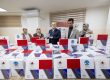
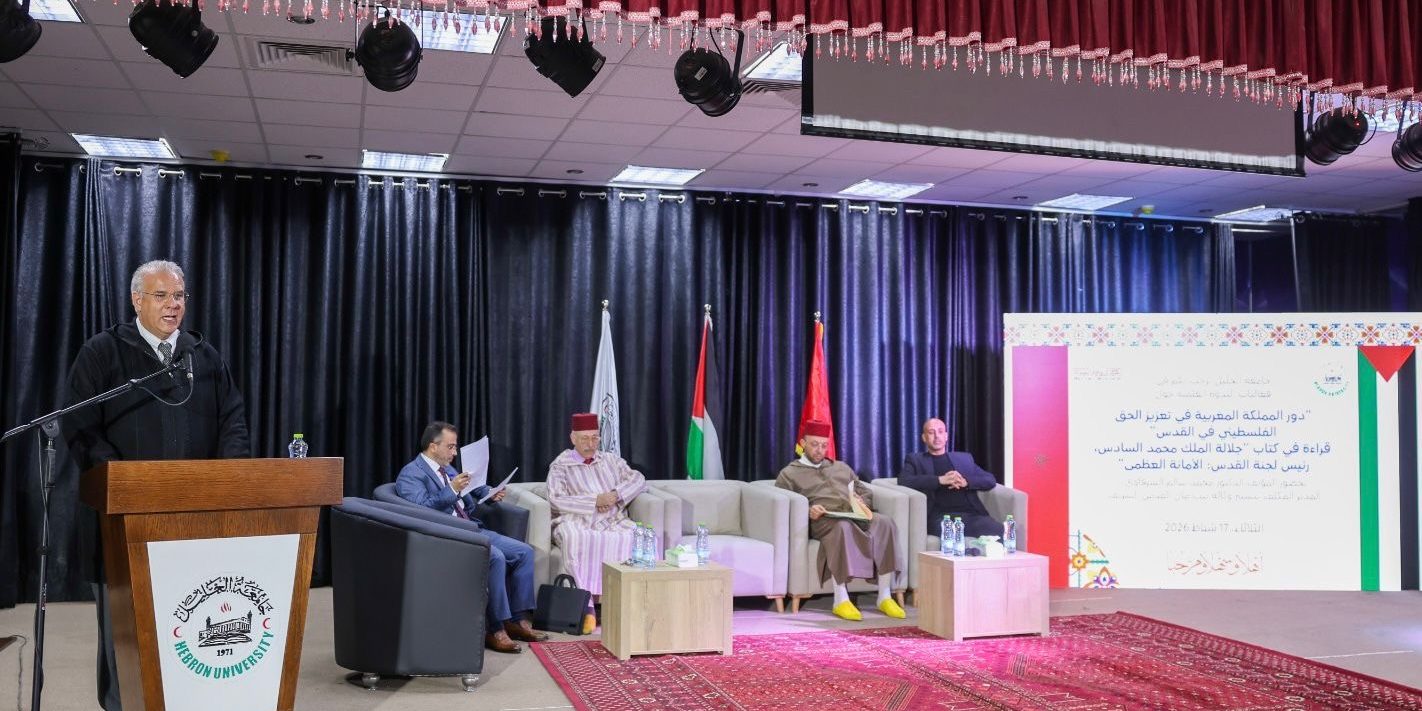
Hebron — Moroccan and Palestinian researchers underscored the profound spiritual and historical bonds connecting Morocco and Jerusalem during a scientific seminar held Tuesday at Hebron University under the theme “The Role of the Kingdom of Morocco in Strengthening Palestinian Rights in Jerusalem.”
Participants emphasized that Morocco’s relationship with Jerusalem extends beyond political considerations, being deeply anchored in shared spiritual, historical, and civilizational ties. The seminar was attended by Hebron University President Raghd Dweik, former Palestinian Minister of Endowments Sheikh Hatem Al-Bakri, President of the Moroccan-Palestinian Friendship Association Ziad Al-Jaabari, along with trustees, faculty, and graduates of Moroccan universities and higher institutes.
They also expressed Palestinian appreciation for the sustained efforts led by His Majesty King Mohammed VI, Chairman of the Al-Quds Committee, in defending Jerusalem and strengthening Palestinian resilience in the city.
On this occasion, Moroccan historian Mohammed Sammar presented a paper titled “From Morocco to Jerusalem and Hebron: Traditions of Moroccan Attachment to the Holy Lands,” examining the historical and spiritual dimensions of the King’s chairmanship of the Al-Quds Committee, which he described as a “sacred trust” rooted in Morocco’s civilizational and ethical heritage.
He emphasized that Morocco’s leadership of the Al-Quds Committee reflects a profound historical bond with Jerusalem spanning more than a millennium, evident in Moroccan scholarly, architectural, and spiritual presence, particularly within the historic Moroccan Quarter.
He also highlighted the significance of the “Jerusalem/Al-Quds Call,” signed by King Mohammed VI and Pope Francis in March 2019, describing it as a landmark document reinforcing the city’s spiritual and humanitarian character and its status as a shared heritage of humanity and a symbol of coexistence.
Hebron University political science professor Imad Al-Bashtawi presented a paper titled “Royal Chairmanship of the Al-Quds Committee: Reality and Prospects,” examining the political and legal frameworks shaping King Mohammed VI’s leadership, noting that this role ensures continuity and stability in defending Jerusalem. He stressed the need to strengthen diplomatic tools, expand regional and international partnerships, and reinforce the field efforts of Committee-affiliated institutions to address the city’s mounting challenges.
Mustapha Fawzi, President of the Local Scientific Council of Casablanca–Ain Chock, discussed the religious and legal dimensions of the “sacred trust” entrusted to King Mohammed VI as Chairman of the Al-Quds Committee, emphasizing the deep historical and moral responsibility this entails.
Mohamed Salem Echarkaoui, Director of the Bayt Mal Al-Quds Asharif Agency (BMAQ), explored Morocco’s historical, national, and religious ties to Jerusalem, affirming that the King’s chairmanship reflects the depth of Morocco’s longstanding spiritual connection to the city. He noted that his 2024 book The Sacred Trust documents the Committee’s work through two complementary tracks: political-diplomatic action and humanitarian field initiatives implemented by BMAQ.
He concluded that Jerusalem will remain central to Morocco’s official and popular priorities, emphasizing that strengthened coordination, effective diplomacy, and sustainable field initiatives are crucial to safeguarding the city and preserving its historical and cultural identity.
The session was moderated by Hebron University political science professor Bilal Shobaki, as part of a discussion of Echarkaoui’s book ‘His Majesty King Mohammed VI, Chairman of the Al-Quds Committee: The Sacred Trust’.